
Dairy or vegetable proteins: How to design more efficient calf milk replacers
By Nicolas Anglade, Category Manager Ruminants, Hamlet Protein
The dairy vs. plant protein debate in calf milk replacers (CMRs) is becoming irrelevant. Sustainability depends on the overall system efficiency, not protein origin alone. Dairy proteins offer superior nutritional value but have high environmental footprints, while legume proteins have lower crop-level impacts but require processing to improve calf digestion (HP100, Hamlet Protein). Key to sustainability is nitrogen use efficiency, with research showing that combining both protein types can maintain calf growth while reducing nitrogen excretion by about 19%. Ultimately, future milk replacers should use complementary dairy and plant proteins strategically, rather than relying exclusively on either source.
How long will we have the luxury of choosing between dairy and plant proteins for CMR?
For years, the formulation of CMRs has centered on two essentials: digestive safety and raw material cost. Today, a third dimension is becoming increasingly important in modern livestock systems: how well nutrients are utilized and how efficiently agricultural resources are allocated.
Protein impact extends beyond animal performance. The overall carbon footprint of the production system, the use of agricultural resources, and the role of each ingredient within the nitrogen cycle must also be considered.
A protein with a low environmental impact at crop level can still underperform if digestibility is poor. Conversely, a protein that requires more resources to produce may still be justified if it leads to higher nutritional efficiency and lower nutrient losses.
Resource efficiency also involves using each resource where it brings the greatest value. When applied to dairy proteins, this question must be considered from a long-term perspective. The allocation of high-quality proteins between feed and food has always influenced both availability and market prices. Under increasing constraints on agricultural production (including climate pressure, labor availability, land use and economic viability), a key question is whether proteins with high biological value will remain available in unlimited quantities for animal feeding.
Demand for dairy proteins in human nutrition is growing rapidly, driven by infant formula, clinical nutrition for elderly or overweight individuals, sports nutrition, and the overall rise of high‑protein diets. Current estimates suggest an annual demand growth of 5-7%, whereas global milk production increases by only 1-2% per year. This imbalance raises critical questions about how dairy proteins will be allocated between human nutrition and animal feeding in the future.
The challenge is therefore no longer to choose between dairy and plant proteins, but to design milk replacers that maximize biological and environmental efficiency within an increasingly constrained and rapidly evolving production system.
Dairy proteins are a nutritional reference, but a resource-intensive system
Dairy proteins remain the reference for feeding pre-ruminant calves. Their digestibility is high, their amino acid profile is well-balanced, and their metabolic utilization is efficient. They support optimal growth, reduce the risk of digestive disorders and provide a high level of confidence for both farmers and feed partners.
However, this nutritional efficiency relies on a complex and resource-intensive production system. Producing dairy proteins require growing forages and procuring grains or meals to feed dairy cows, managing effluents, producing raw milk, transporting and processing it into dairy products and co-products before part of it is finally used in CMRs. Each step requires agricultural land, energy and mineral inputs, including nitrogen and phosphorus.
The nitrogen cycle plays a central role in the environmental footprint of milk production. Nitrogen is a key component of amino acids and therefore of proteins, but its use in agriculture is associated with unavoidable losses. Crops grown for ruminant feeding require fertilization, and part of this nitrogen is lost as nitrates, ammonia or nitrous oxide, the latter being a particularly potent greenhouse gas. Additional emissions originate from enteric fermentation and manure management.
Life cycle assessment (LCA) studies quantify these impacts. Average values often reported for milk production are around 1 kg CO₂-eq per liter of milk, depending on the production system and allocation method. However, one liter of milk contains only about 13% dry matter and approximately 3.3% protein. When expressed per kilogram of protein, the carbon footprint increases considerably, which explains why industrial dairy ingredients such as skimmed milk powder may reach values in the range of 8 to 10 kg CO₂-eq per kilogram of product for 34-35% of protein content.
The high nutritional value of dairy proteins still justifies their use in young pre-ruminant animals. Nevertheless, their environmental cost suggests that their inclusion should be carefully managed, reserving them for situations where their biological efficiency provides a clear and measurable benefit.
Plant proteins have a favorable environmental footprint but need to be processed for smooth digestion
Plant derived proteins, such as legumes, can offer advantages related to nitrogen management at crop level when produced within responsible sourcing systems. Through symbiosis with soil bacteria, legumes can fix atmospheric nitrogen, which can reduce the need for synthetic nitrogen fertilizers and associated greenhouse gas emissions during crop production.
In addition, legumes may contribute positively to crop rotation systems. Their inclusion can improve soil nitrogen balance, lower fertilizer requirements for subsequent crops, and help limit nitrogen losses in arable farming. For these reasons, legume-based protein crops are often highlighted for their potential role in improving nitrogen efficiency within feed production systems.
Soybean remains the most widely used plant protein source in animal nutrition worldwide. Its high protein concentration and favorable amino acid profile make it a valuable raw material for feed formulation. Under responsible supply chain conditions, including the absence of deforestation, published life cycle assessments indicate that soybeans often show a lower crop-level carbon footprint than some animal derived protein ingredients, depending on production system, geographical origin and allocation methodology. Values in the range of 0.4–0.6 kg CO₂-eq per kg of soybean are often reported, for a protein content of approximately 35–38%.
However, the advantages observed at crop level do not automatically translate into improved efficiency at animal level. In young animals, protein digestibility and gut health are critical factors influencing nutrient utilization. Certain plant derived raw materials may contain anti nutritional factors (ANFs) that can impair nutrient absorption, reduce feed efficiency and increase nitrogen excretion if not adequately addressed.
For this reason, the use of plant proteins in calf nutrition requires specifically adapted ingredients and processing methods. Technological approaches such as enzymatic treatment of soybean meals can reduce ANFs and improve digestibility. When correctly applied, these improvements support more efficient use of plant proteins, helping maintain animal performance while improving nutrient utilization and nitrogen use efficiency within the feeding program.
Nitrogen use efficiency is an important factor in resource‑efficient calf nutrition
The environmental impact of a CMR depends not only on the origin of the protein sources, but also on how efficiently these proteins are utilized by the animal. A well-digested protein is converted into growth, whereas poorly metabolized protein leads to increased nitrogen excretion.
Nitrogen losses are directly associated with emissions of ammonia and nitrous oxide, two major contributors to the environmental footprint of livestock production. Improving nitrogen‑use efficiency therefore represents an important lever for influencing nitrogen‑related emissions at farm level and improving overall nutrient utilization in young animal feeding programs.
Recent trials conducted in collaboration with the University of Warmia and Mazury (Poland, 2024) evaluated milk replacer formulations combining dairy proteins with selected plant proteins. In these trials, part of the dairy protein from skimmed milk powder was replaced by enzyme-treated soybean meal (HP 100, Hamlet Protein). Growth performance of pre-ruminant calves was maintained throughout the trial period, while nitrogen excretion was significantly reduced by approximately 19% compared with the all-dairy formulation (Fig. 1).
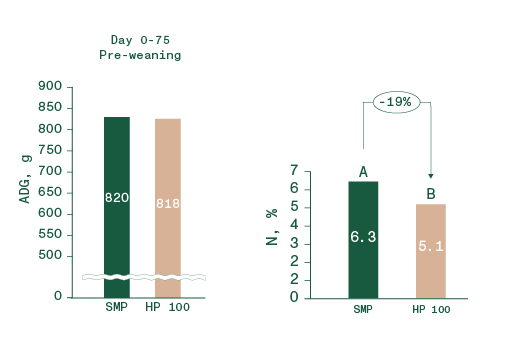
Figure 1: Substituting skimmed milk powder with enzyme-treated soybean meal (HP 100, Hamlet Protein) in calf milk replacer results in similar pre-weaning growth rates (left) and reduced nitrogen excretion (right), indicating improved nitrogen use efficiency.
These results illustrate that protein complementarity can be used as a technical tool to improve overall efficiency. Dairy proteins provide high biological value and digestive safety, while selected and processed plant proteins support efficient nutrient utilization. When properly combined, these sources can deliver better overall performance than the exclusive use of either one.
This approach is consistent with the principle of “doing more with less”. Producing more with fewer resources requires precise formulation, carefully selected feed ingredients and high digestibility. Improving nitrogen‑use efficiency is therefore not only a nutritional objective, but an important component of resource‑efficient feeding strategies in young animal nutrition.
Strategic use of both dairy and plant proteins results in more resource‑efficient formulation of milk replacers
Designing modern calf milk replacers requires more than simply replacing one protein source with another. Effective formulation depends on aligning nutrient composition with the physiological needs of young animals, while taking into account the technical and resource‑related constraints of modern livestock production.
Future milk replacer strategies are therefore unlikely to rely exclusively on either dairy‑based or plant‑based formulations. Instead, they increasingly focus on the complementary use of different protein sources, selected and combined to support digestibility, growth performance and efficient nutrient utilization.
This evolution requires a deeper understanding of raw materials, the use of technological processes that improve digestibility, and more precise formulation strategies to optimize nutrient utilization. It also requires responsible supply‑chain considerations, such as sourcing practices and processing methods, that influence input requirements and resource use.
As parameters such as nitrogen‑use efficiency, land use and carbon‑related metrics become more relevant to production decision‑making, formulation approaches must continue to adapt.
Progress in calf nutrition is therefore less about selecting a single ideal protein source and more about using each ingredient where it delivers the greatest biological efficiency within the feeding program.
The next generation of milk replacers will depend on the ability to combine consistent animal performance with precise nutrient utilization, supported by well‑informed formulation choices and appropriate processing technologies.
The focus is not “dairy vs plant,” but nutrient efficiency for managing resources responsibly across the feeding strategy.
References available upon requests to the author.
Key takeaways
Dairy proteins: high digestibility, high footprint
Plant proteins: lower crop impact, require processing
Best solution: combine both
Result: up to 19% lower nitrogen excretion
What is the best protein source for calf milk replacers?
The most efficient approach combines dairy and plant proteins to balance digestibility, growth performance, and environmental impact.
Why not use only dairy protein?
Dairy proteins are highly digestible but resource-intensive, with a higher carbon footprint per kilogram of protein.
Are plant proteins suitable for calves?
Yes, when processed correctly to remove anti-nutritional factors and improve digestibility.
How much can nitrogen excretion be reduced?
Trials show reductions of approximately 19% when combining dairy and processed plant proteins

About HAMLET PROTEIN
